Verlen Kruger and Valerie Fons' Long Trip
- Verlen Kruger and Valerie Fons' Long Trip - Continue to Part 2
- Verlen Kruger and Valerie Fons' Long Trip - Continue to Part 3
- Verlen Kruger and Valerie Fons' Long Trip - Continue to Part 4
- Verlen Kruger and Valerie Fons' Long Trip - Continue to Part 5
Part 1 - An Achievement - the Mother of Journeys: "Two Continent Canoe Expedition"
First published in SCA JULY/AUG 2003 #22
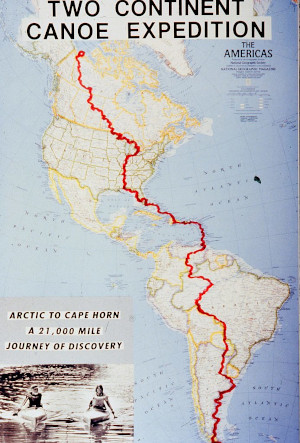 I was looking at their tan coffee mug with the map of North and South America, showing their route from above the
Arctic Circle to Cape Horn, and dates along the way. Verlen and Valerie look back from their boats, a banner between them
reads "Two Continent Canoe Expedition."
I was looking at their tan coffee mug with the map of North and South America, showing their route from above the
Arctic Circle to Cape Horn, and dates along the way. Verlen and Valerie look back from their boats, a banner between them
reads "Two Continent Canoe Expedition."
They're over-achievers - Verlen and Valerie. They might be the ultimate "cartop cruisers," or expand that to include boat, plane, and train cruisers. But their ratio of boat miles to other miles is the opposite of the ordinary cartop cruisers. We drive a thousand miles and take mostly short trips. Verlen and Valerie stepped into their canoes in June of '86, a hundred miles north of the Arctic Circle. In March of '89, they reached Cape Horn, using "other" transportation across only those spots impossible for mortals.
Verlen Kruger was at the Lansing, Michigan Quiet Water Symposium the 1st of March '03. He's 81 now and leans on a walking stick, wife Jenny at his side. He was in my Essential Gear column of issue #15. He's now paddled over 90,000 miles. He and Jenny have 9 children, 35 grandchildren and 13 great-grandchildren.
Born an Indiana sharecropper's son, Verlen quit school at 14 to help the family. He was drafted into WWII and became a tank driver. Later he qualified for the Army Air Force Flight Training School, became a flight instructor, and flew P-51s over Korea. He holds many Guinness Records, including the "Ultimate Canoe Challenge," a 28,000 mile infinity-sign track around North America in '80-'83, most paddled with his son-in-law, Steve Landick, and 2400 miles with Valerie. In '84 Valerie and Verlen set a record paddling down the Mississippi in 23 days, 10 hours, and 20 minutes.
His blue eyes still sparkle above his white beard. He speaks softly with an easy manner. A mix of Santa and helper, he's more fireplug than elf, though, having sat and paddled, quite possibly, more miles than anyone ever-with a single-blade paddle, and no backrest.
* * *
 The late Ned Sharples, who began Canoesport in Ann Arbor, introduced me to Verlen by phone in 1986. Ned was Mark
Balogh's and my first costumer of a venture of sails for canoes and kayaks. I was the backer, marketer, boat and hardware
supplier. Ned bought our first sails.
The late Ned Sharples, who began Canoesport in Ann Arbor, introduced me to Verlen by phone in 1986. Ned was Mark
Balogh's and my first costumer of a venture of sails for canoes and kayaks. I was the backer, marketer, boat and hardware
supplier. Ned bought our first sails.
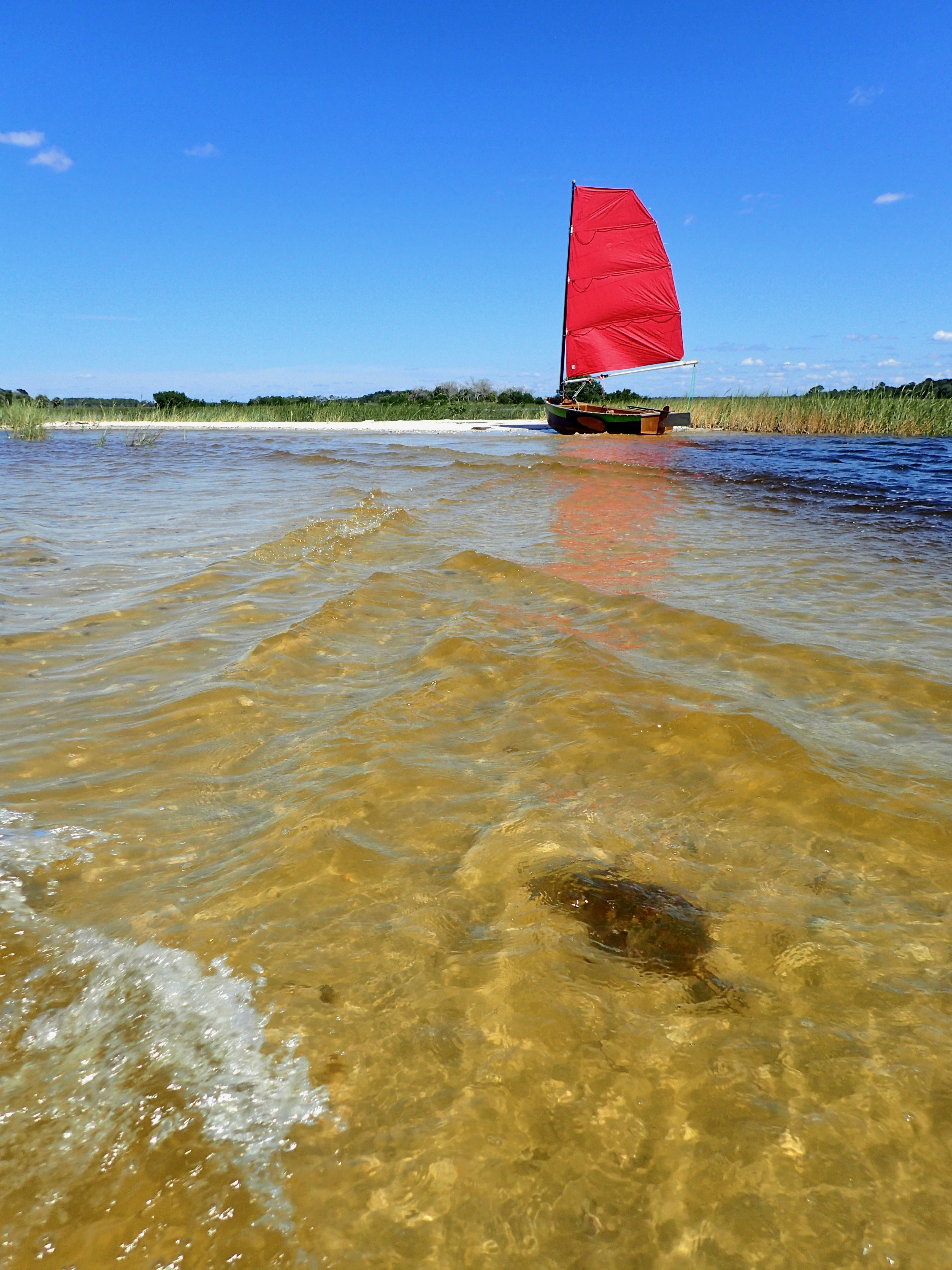
I met Verlen and Valerie face-to-face on the Wabash River in Indiana in early '87, looked at their boats, and agreed to meet them with rigs in Pensacola. He'd built their canoes to catamaran together with fiberglass poles, and, although neither were sailors, they were hoping they'd learn along the way when catamaranned.
On the Wabash we shared the floor of a log, community lodge - Verlen the powerful elf in red synthetic long Johns and white beard, and strong, striking Valerie with her clear alto commentary.
That night they told of a thumping northeasterly near - blizzard a few weeks before. It was on the day they came through Lake St Clair, between lakes Erie and Huron, near Detroit and a few miles from Kayann's and my home on the Clinton River. The St Clair shore on the American side is 99% steel-sheet pile seawalls. It's a hideous treatment of a shoreline. It gave Valerie and Verlen grief, too, with reflected waves and no place to pull out.
They called in weekly to the most popular radio show Detroit has had, JP McCarthy on WJR. V&V quickly acknowledged the accomplishment was not all under their own power, since Verlen had broken his ribs early on the Mackenzie. To keep schedule, they'd used an outboard until Verlen was able to paddle again.
They've been criticized for not being more clear how the whole trip was traveled. After they realized they'd be padding against the wind in the Caribbean, I think it was understood travel by ferry, plane, train, & car would be appropriate at times. They just couldn't predict which and when. So, they filled in impossible gaps as prudent people would. Verlen has enough Guinness records and Valerie has hers. To me, though, the gaps are interesting, too. They provide a complete story, and show us cartop cruisers what can be done.
Valerie emailed in late April '03 about the day on Lake St Clair, "following is my journal entry for Dec. 8, 1986: We made a big mistake that could have been life threatening. Verlen felt the pressure of getting to Detroit for our press appointments on December 11, the day we were supposed to arrive at Belle Isle (Detroit)."
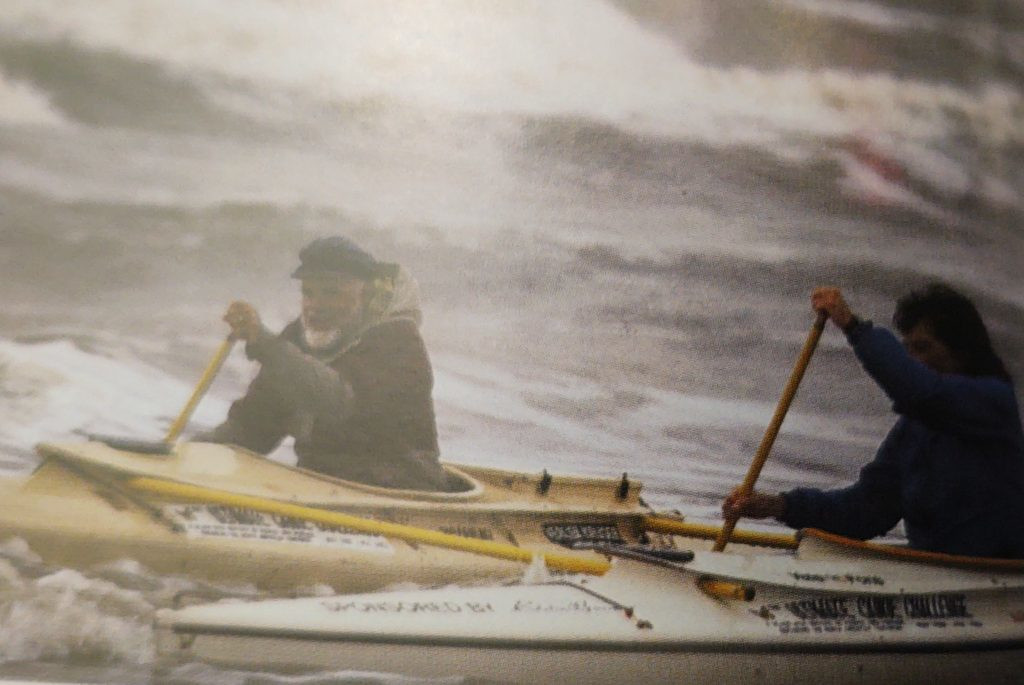 She told a goose bump tale of being on the fetch end of the twenty-mile diameter lake in a December northeasterly,
heavy snow squalls aided by 'lake effect.' She emailed, "we tried to stay out, thinking that the waves were caused by the
surf pounding on the break walls (sea walls) but the entire area as far as we could see was climbing waves.The sky was
grey and the water all a brown color. The hue was ugly, and there was no where to land, finally we edged closer to the shore,
trying to find a channel... ."
She told a goose bump tale of being on the fetch end of the twenty-mile diameter lake in a December northeasterly,
heavy snow squalls aided by 'lake effect.' She emailed, "we tried to stay out, thinking that the waves were caused by the
surf pounding on the break walls (sea walls) but the entire area as far as we could see was climbing waves.The sky was
grey and the water all a brown color. The hue was ugly, and there was no where to land, finally we edged closer to the shore,
trying to find a channel... ."
Then the Coast Guard arrived. In attempting to get themselves and their boats aboard the "cutter," Verlen in the catamaranned canoes was let loose inadvertently after he'd handed his paddle to the Coast Guard. Valerie wrote, "There was Verlen floating in the lake on the swells with no paddle to control his movement, or turn the bows into the waves. The expression on his face was a grimace of hopelessness.
That Coast Guard man threw his paddle to him, even as I screamed -'Don't throw the paddle.' Verlen missed catching the paddle and there was the paddle floating away. My thoughts had been "we can't lose the boats. It didn't occur to me that Verlen and I weren't safe. I just knew it was imperative that we save the canoes... ."
But those events of several weeks before were forgotten in the morning on the ice-edged Wabash - a scene I've never forgotten. For me it has defined boats of "expedition quality." Their heavily loaded boats were on a launch ramp. Several families stood in the cold, wishing them well. The edge of the side of the concrete ramp was old and raw, with steel showing.
Verlen casually skidded those heavily loaded boats over the edge, unconcerned whether concrete or rebar, their full weight point loaded along their bottoms, before they reached the water. (The hulls are solid Kevlar, so thick they're about 20% heavier than our notions of foam-cored lightness. But of course, other than portaging, at the displacement he and Val were using the boats the extra dozen or so pounds was insignificant.)
* * *
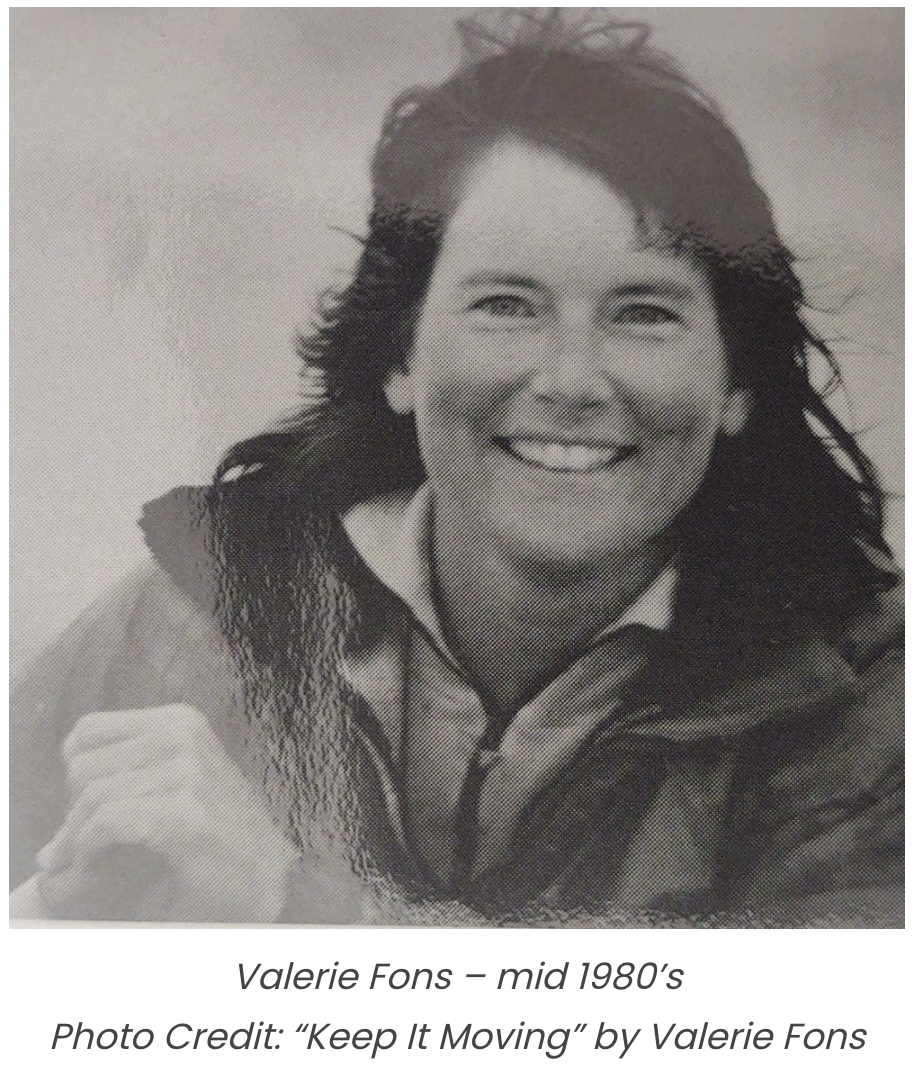 Valerie met Verlen at Green Lake in Seattle. He was in the middle of his 28,000 mile Ultimate Canoe Challenge with his
son-in-law. She'd begun canoe racing and was there for a race. It was a press/layover stop for Verlen and Steve Landick.
Later, after Verlen capsized off the Oregon coast in July and was rescued by the CG but lost his boat, Valerie gave him a
ride back to Seattle. His second boat was shipped from Michigan to Seattle where Verlen built it's spray deck and readied
it for sea. They drove back to Oregon and got the news his original boat was found, in which he wanted to continue the
trip. The new boat was with Valerie.
Valerie met Verlen at Green Lake in Seattle. He was in the middle of his 28,000 mile Ultimate Canoe Challenge with his
son-in-law. She'd begun canoe racing and was there for a race. It was a press/layover stop for Verlen and Steve Landick.
Later, after Verlen capsized off the Oregon coast in July and was rescued by the CG but lost his boat, Valerie gave him a
ride back to Seattle. His second boat was shipped from Michigan to Seattle where Verlen built it's spray deck and readied
it for sea. They drove back to Oregon and got the news his original boat was found, in which he wanted to continue the
trip. The new boat was with Valerie.
In October Steve visited Michigan. On his first full day home his daughter, Saba Dawn, Verlen's Granddaughter, died from SIDS; Steve decided to stay. Verlen asked Val if she could continue with him from Long Beach, California down the coast, around Beja and up to Yuma, Arizona.
In'88 in Brazil, Verlen wrote the epilog of One Incredible Journey (about a 7000 mile dash with Clint Waddel in '71 across the North American Continent). "Eventually our teamship developed into romance. Jenny and I decided to go our separate ways in summer of 1984. Valerie and I were married on April 3, 1986. Our combined energy, love and dreams soon created... the Two Continent Canoe Expedition."
Valerie emailed, "Verlen's original idea was Tuk in the Arctic to Buenos Aires. I looked at the map and said that he stopped short and we should go to Cape Horn. He agreed."
I look again at their tan coffee mug. They left the mouth of the MacKenzie River above the Arctic Circle in June of '86. In October they were in Lake Superior, and in December they passed through Lake St Clair at Detroit. They paddled down the Tombigbee Waterway, through mobile, Alabama, and to Pensacola.
My son, Dural, and I met them at a Coast Guard station as we drove north towing our Aleutka cutter to Michigan. I delivered their rigs and set them up. Verlen glassed in the mast steps and cut the holes for the masts.
On the Wabash and again in Pensacola, I talked about the Gulf stream crossing, prevailing winds, potential weather. My thought was that they should have begun at Cape Horn and come North, to have favorable winds in the Caribbean, not to mention being able to go down the MacKenzie.
They were in Miami in March, getting ready for the Gulf stream. They left Key Largo.
In late April of '03, Verlen and I talked on the phone. We were looking back on all the trips, particularly the Two Continent, and how some of it seemed unbelievable even though we knew it was true. He thought so, too, and said even to him "Some of it seems 'a stretch.'"
~HH