Verlen Kruger and Valerie Fons' Long Trip
- Verlen Kruger and Valerie Fons' Long Trip - Back to Part 1
- Verlen Kruger and Valerie Fons' Long Trip - Back to Part 2
- Verlen Kruger and Valerie Fons' Long Trip - Continue to Part 4
- Verlen Kruger and Valerie Fons' Long Trip - Continue to Part 5
Part 3, "An Achievement - the Mother of Journeys," continues
First published in SCA NOV/DEC 2003 #24
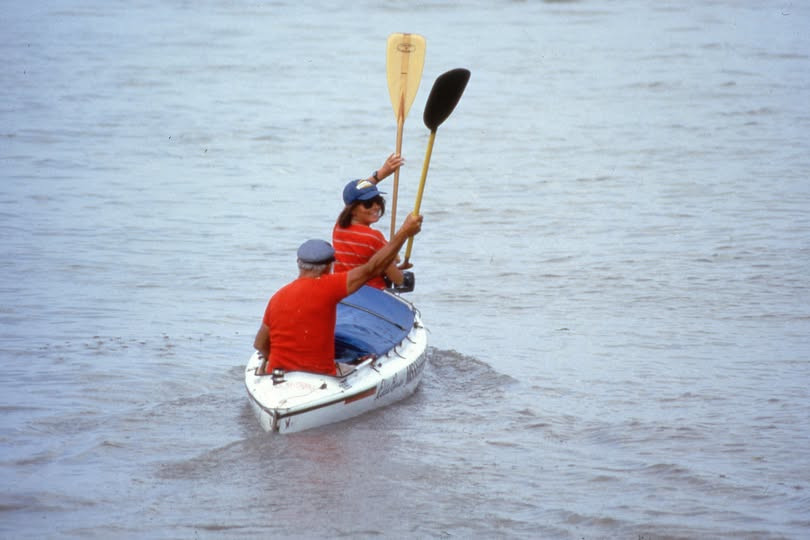 In mid 1988 Valerie Fons and Verlen Kruger were 14,000 miles into their Two Continent Canoe Expedition -about two
thirds of their way to Cape Horn- in Brazil's Mato Grosso, the vast, then very wet savanna, on the south side of the
Amazon Basin.
In mid 1988 Valerie Fons and Verlen Kruger were 14,000 miles into their Two Continent Canoe Expedition -about two
thirds of their way to Cape Horn- in Brazil's Mato Grosso, the vast, then very wet savanna, on the south side of the
Amazon Basin.
With Valerie's, "determination, all that we could give and more, the encouragement and help of others, and by the grace of God," and Verlen's, "the spirit of whatever it takes," they and their loaded canoes rode a truck with rough-cut lumber into the Paraguay and Parana drainage, chasing the time window to Cape Horn.
In the backs of their minds was the South Atlantic to come, and Verlen's worsening eye pain.
"The Pantanal was totally different - no trees, semi-barren country. But with the highest floods ever, it didn't look right. Higher ground was alive with wildlife and bird-life," Verlen said.
They left the jungle and the "howler monkeys which," Valerie emailed, "sounded at night like lions and tigers for neighbors." They left "parrots darting across across the river - flashes of bright color - and butterflies in swarms along the bank and dragon flies on deck that kept me company. We should have been thinking about the ocean, but the jungle had a way of taking over."
"The Pantanal," Valerie continued, "the huge, flooded swamp area was most challenging. The river gave way to ocean-like proportions." They bounced a night away in swells, tethered to a floating palm, in the thin lee of its wad of flotsam, all the while transported with the Paraguay's current. Usually they anchored and slept above deck on three boards carried from Manaus, Brazil.
Once, the route through the Pantanal was blocked by floating vegetation adrift from strong winds. They tried for days, but couldn't get through. They paddled back nearly two hundred miles, then rode a small flatbed truck to the next tributary. Valerie's voice still carries anguish and indignation from that near 200 mile retreat, costing at least ten days.
But above Corumba, Brazil, her journals had happy days of much sailing - predawn to sunset, several days over 50 miles. They liked Asuncion. It's Paraguay's capital, less than a half million people. They arrived, "on the exact day of the floods peak. Streets were flooded - never did see a dock. I think the Paraguay at Asuncion was bigger than the Ohio River, although it was hard to tell." They picked up a shipment of a hundred plus pounds of food, and were met by the president of Paraguay's canoe clubs. "And," Valerie said, "Asuncion was wonderful because of a host family with extraordinary kindness," continuing their praise for South America's canoe clubs.
In late August of 1988 they entered Buenos Aires, Argentina on the Rio Parana, sailing in a channel off the enormous river. Many kyakers them. Verlen was astonished with the city's spread, and over 10,000,000 population. He was elated to find and enjoy, with Valerie's help, each of the city's five McDonald's restaurants.
I asked Verlen what was the strongest memory of the Paraguay and Parana Rivers. "So few dams. Only saw two in all of South America!" He paused, "Near Asuncion, the uniqueness of forested hills with patches of different colors - very different flowering trees. It was probably the right season, and with all the rain... ."
"People stories are still the best for me," Valerie said. She'd been photographing women. These images, when she finally saw the, begged to be shown and became part of a 25-print, fully captioned and sponsored exhibition in 1991 called "Faces of Strength."
"We come ashore at a small estancia (ranch). The woman kills her chicken to make a feast in our honor. By the time the meal is cooked it is dark. She has no electricity so I get flashlights. Leaving the next morning we get milk from their cow. I am crying and she is crying as we leave. I have a photo with the caption, 'A new calf is sheltered in the shed behind the kitchen; she cares for it as if it were a child'."
Although Verlen was happy to see the ocean, it was not a relief. He was worried about Valerie. Over 3500 miles lay ahead with much surf. It would not be like the blissful 1000 miles sailing up the Orinoco, nor as simple as paddling over 1500 miles up the Madeira.
While crossing 50 mile wide Samboronbom Bay, they were caught by heavy wind slanted onshore. A high tide gave dry land camping on the flat coast. Two Brazilian kayakers arrived. The wind blew for days. Verlen practiced surf exits with a small sea anchor. The wind blew the water out of the shallow bay, and it stayed out for days.
Mud was seaward for miles. "The kayakers were out of supplies, so they wanted to paddle out of the bay. We had ample water, but not enough to share for any length of time. So we pushed off into the mud, their kayaks tied to our catamaranned canoes. We waded with our weight on the cross poles. Valerie got in the last kayak to take pictures."
Just inside Punta Norte on the southeast side of Samboronbom Bay, they found a place to tuck in through mild surf. But they knew hundreds of miles of big surf was ahead.
Valerie said, "Birds flew in a building and hit a glass window trying to get out. A woman picked up a dazed bird to wash off blood and put it outside. It startled me."
The next day they got out through the surf - the easy part as we know. Later that day, both were tired and edgy, anticipating going in with the surf. Valerie was ready for shore, but they couldn't find an easier spot. People at a village on the beach saw them.
Verlen said, "it was mean surf, choppy, about head high. An inflatable with a small motor came out. We tried to figure out what they were hollering in Spanish. We debated." They decided it was as good a place as any. Valerie wanted the boats catamaranned so he did. "Valerie was paddling like mad. I tried to back paddle and yelled to slow down. But I saw I'd better keep up, so paddled like crazy to match her to get the boat straight. But we were too fast down a wave."
"When we broached, I was still fighting it until about 45 degrees. Both poles snapped." Valerie was low in the trough; Verlen was high. Her bow hit the sand - all weight went on the poles. Valerie was thrown out, but the boats didn't capsize. Verlen grabbed the stump of pole from Valerie's canoe, and yelled to hang onto her boat. The next wave wrenched the pole away, cutting his hand, and Valerie stood up.
 After the crash Valerie said, "I think I got bumped." "What do you mean?" Verlen asked. "My head," she said. The canoe
had hit her head near the base of her neck.
After the crash Valerie said, "I think I got bumped." "What do you mean?" Verlen asked. "My head," she said. The canoe
had hit her head near the base of her neck.
"The whole back of my head was like ice."
Verlen found no injury, but he couldn't ask Valerie to endure more ocean. Big surf went for hundreds, maybe a thousand miles south with sea getting colder, winds stronger. They decided to parallel the coast on rivers as best they could. Canoe clubs of every town offered rides, help, anything and everything.
"After my head injury I felt as if we had been the dazed bird, seeing what we thought was a pass through the surf, then getting hit by it as the bird hit the glass. We weren't thinking. We tried to go in through surf in the catamaranned canoes, our home in the jungles for 6 months. We didn't adapt. We weren't ready. We had been lulled. We were jungle creatures and the ocean spat us out and told us to get our act together."
She felt the call to the ministry that day, before coming in through the surf.
A photo from a helicopter shows them paddling, catamaranned, near a right whale. This is in one of the twin bays of the Valdes Peninsula. They were invited by the Long Term Whale Research Institute and transported by an Argentine canoe club member's truck.
The Argentine canoe clubs took them to a "petrified forest rivaling ours," Verlen said. "It was a tourist attraction. Petrified hollow trees were big enough for kids to crawl through."
Most rivers in southeast Argentina flow east out of the mountains, so aren't useful for south-bound travelers. But the clubs took them to the Rio Chubut, Rio Chico, and Rio Deseado, down which they paddled to the sea and south as far as was prudent. Club members took them to Lago Argentino. They paddled to its head to see the relatively fast glacier calving, then paddled out of the lake and over 200 miles down the Rio Santa Cruz to the South Atlantic.
Verlen chuckled, "We arrived in Punta Arenas (Chile) by bus. People hanging on the outside, boats on the roof."
The last supply point was Puerto Williams, 150 miles southeast. Seventy miles further was Cape Horn. His eyes got worse. "I could see - it was just painful. I thought I could wait, but Valerie and her mom decided I should have my eyes checked in Texas, so I went. Doctors said I could continue, and I flew back to Punta Arenas."
Valerie emailed, "After Verlen went back, I was by myself. I hopped a ride on a boat going to Antarctica. In the Drake passage I got sea sick and lost cranial or spinal fluid through sinus passages. To be safe the doctor on board had the Captain turn the ship around in the lee of a Wollaston Island. I was handed to a Chilean navy boat that took me to the hospital in Punta Arenas. Weeks later I was evacuated to Houston for neurological tests. I arrived home (Houston) in a wheel chair. Verlen had decided to go back to the route and continue with or without me. The doctor in Houston told me to quit the trip."
"Valerie went home," Verlen said. "I stayed to go on, but I knew she'd change her mind."
~HH