Verlen Kruger and Valerie Fons' Long Trip
- Verlen Kruger and Valerie Fons' Long Trip - Back to Part 1
- Verlen Kruger and Valerie Fons' Long Trip - Continue to Part 3
- Verlen Kruger and Valerie Fons' Long Trip - Continue to Part 4
- Verlen Kruger and Valerie Fons' Long Trip - Continue to Part 5
Part 2, "An Achievement-the Mother of Journeys," continues:
First published in SCA SEP/OCT 2003 #23
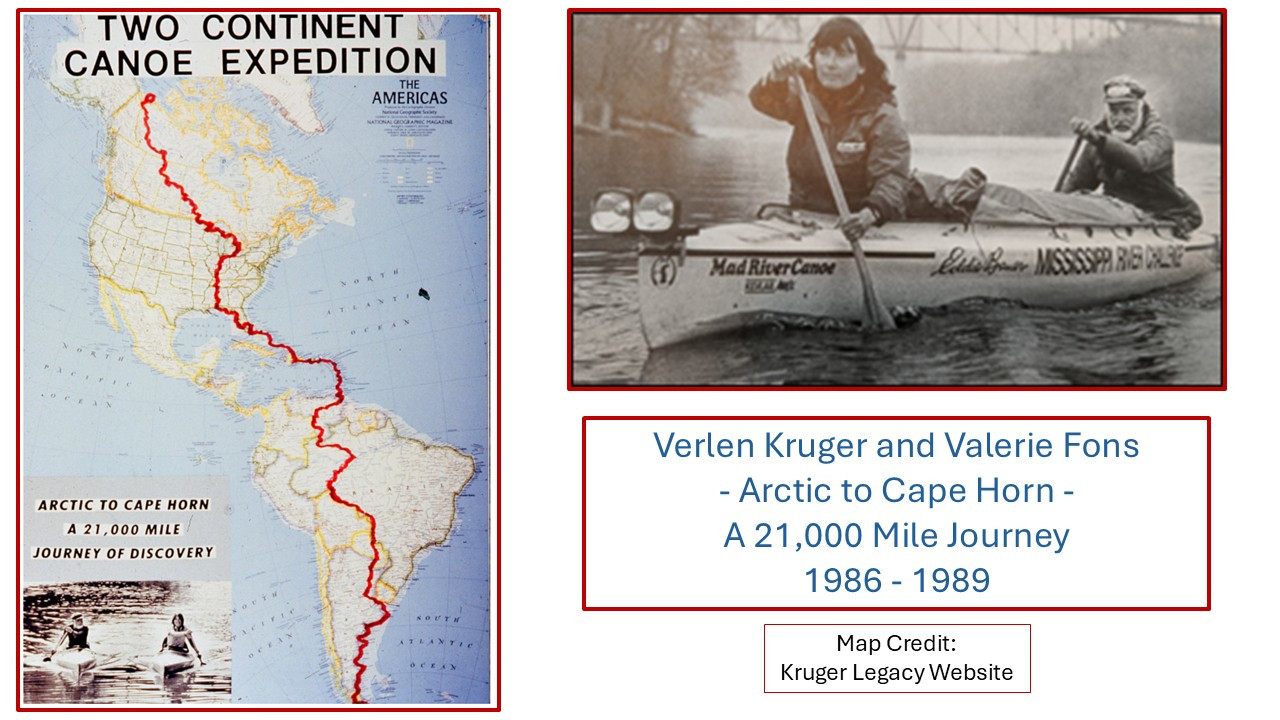 In June of 1987, Valerie Fons and husband Verlen Kruger paddled in their sail-equipped, decked canoes, catamaranned
together, from Key Largo, Florida into the Gulf Stream, for Gun Cay in the Bahamas, seventy sea miles across the Florida
Strait. They were over 8,000 miles into their "Two Continent Canoe Expedition," and about a third of the way into an "A"
for achievement - with adjectives: astounding, astonishing, amazing, awesome. They began in June of 1986 a hundred miles
north of the Arctic circle at the mouth of the MacKenzie River.
In June of 1987, Valerie Fons and husband Verlen Kruger paddled in their sail-equipped, decked canoes, catamaranned
together, from Key Largo, Florida into the Gulf Stream, for Gun Cay in the Bahamas, seventy sea miles across the Florida
Strait. They were over 8,000 miles into their "Two Continent Canoe Expedition," and about a third of the way into an "A"
for achievement - with adjectives: astounding, astonishing, amazing, awesome. They began in June of 1986 a hundred miles
north of the Arctic circle at the mouth of the MacKenzie River.
They knew they'd not paddle every mile. Compared to Verlen's 28,000 dash with Steve Landick, which was competitive between them, and with the intent to travel every possible inch by paddle power, this trip with Valerie, Verlen said, was done in the spirit of "whatever it takes."
Too late, ocean sailors had told them their trip was the wrong way in the Caribbean. They'd often face heavy headwinds, at least to the turn south at the Lesser Antilles.
Valerie was seasick within an hour out of Key Largo. By the end of the second hour they were aboard a sailboat that had offered to follow them. Then Verlen got sick. The kindly sailors took them to Cat Cay,south of Bimini. "Boy, were we glad to get out of the boat," Verlen joked on the phone.
The Bahamas are low islands. Compare them to the Pacific's Tuamotu (Dangerous) Archipelago of atolls. The Bahama are shallows with shifting sands and currents, spread over about as much ocean as the Tuamotos, say 90,000 square miles. Being as low as one is in a canoe, looking for low islands, you must be within a few miles to see them.
They left Cat Cay early on June 15th, unescorted, and paddled all day and night east southeast across the Great Bahama Bank. This is a fifty miles swath, a fathom to five deep, dotted with coral. The Florida Strait is west; the thousand fathom Tongue of the Ocean is east of Andros. The Bank is infinitely variegated turquoise, with deep blue on either side. Most sailboats cross only in daylight, anchoring once.
Verlen and Valerie anchored four times. At sundown of the second day they saw land to the south. The Krugers, after forty hours, staggered ashore on an islet at the tip of Andros at 3:35 a.m. of the 17th, their longest stay in the boats.
"A little more ordeal than I expected. The saltwater spray gave us 'saltwater raspberries'." I can imagine Verlen's automaton paddling, hour after salty, wet hour, slowly rubbing. "And we didn't like being out of sight of land," he chuckled. "I was very glad to get ashore."
Valerie remembered the crossing, "... was incredible... some moon through the night, with the waves we were lit like being on screen."
They recuperated a day, but the schedule was nibbling, so the next day they were paddling into the wind again, east southeast toward Nassau, 30 miles away. A couple hours out, a water barge stopped to look. "We were sort of a curiosity," Verlen said. A rusty tug was pushing the barge to supply Nassau from Andros's Morgan's Bluff. (Yes, the pirate knighted Sir Henry Morgan.) Andros is the only Bahamian island with plenty of fresh water. "Being a plumber," Verlen reminded me, "I'm always interested in water supplies."
 From Nassau they paddled southeast to the north end of the Exuma chain. On June 30th they were at Bell Island, a third
of the way down the Exumas, averaging fifteen miles, "in spite of the heat," Valerie told her brother, John.
From Nassau they paddled southeast to the north end of the Exuma chain. On June 30th they were at Bell Island, a third
of the way down the Exumas, averaging fifteen miles, "in spite of the heat," Valerie told her brother, John.
They got to Georgetown on Great Exuma, stayed for a few nights, continued to Hog Cay and paddled to Long Island.
Valerie went to church. "The choir sang, Don't move that mountain that I have to climb, just give me the strength to climb it. I like that, and have sung it ever since."
At the south point of Long Island, they looked across the dark blue of the Crooked Island Passage. Acklins is adjacent to Crooked. With Long Cay, Crooked and Acklins form most of the Bight of Acklins. Columbus sailed into the Passage, along Crooked's lee, and wrote, "fragrant islands."
Crooked/Ackins became one of Verlen's favorite spots on the planet, as it is one of Kayann's and mine - part of our honeymoon. It's so vast and underpopulated now, with people as friendly as anywhere we've been. From the chart it's about the same size and reminds me of the huge Chuuk (ex-Truk) Lagoon, 45 miles by 30. After the Revolutionary War, Crooked/Acklins was a Loyalist center, populated with nearly forty plantations and 1,200 slaves. I often think of the people, black and white, dragged upwind from what's now the southeast U.S. Imagine the temptation to return downwind to lost family and lovers.
Verlen said it was an easy paddle across the thirty mile passage, catching a light air day with the mile-deep water under them. One hundred twelve foot Bird Rock Light would've been visible half way across. The landed on the northwest corner of Crooked Island at Landrail Point, and were welcomed as family.
Valerie and Verlen, devout Christians, appreciated the equally devout Seventh Day Adventists near Landrail point. "They were good, Bible Christians," Verlen said. "It was real to them; their way of life." But, the Crooked Islander treated us like family, too, knowing Kayann was an ex Catholic, and I'm a non-believer.
Verlen plumbed an Islander's new house as the easterly trades increased to normal 10-20 plus knots. It still blew; he installed a bath tub.
Schedule again. They caught a hundred mile, fast pounding ride to Turks and Caicos. They were seasick and happy to land. A British destroyer's First Mate invited them aboard for a substantial dinner.
The next hundred miles, Valerie wrote, "was no 'lux liner'." Verlen said, "It looked on its last legs, but the captain offered us a free ride," to the Dominican Republic. In the middle of the night, sleeping in their boats on deck, "the big diesel conked out. I had my hand on my knife to cut our boats loose, and was making plans."
Valerie wrote, "The engine was smoking. One of the crew climbed below deck whacking the engine with a wrench." Verlen said, "A mechanic with a hammer, I think, finally got it going."
The 23rd of August at Puerto Plata they had, Verlen said, "the worst reception of the entire trip, crooks and thieves... ."
But, Valerie wrote, "I considered the situation of the people to be survival. We were not harmed."
It was too windy to paddle east. They were told they'd need an armed escort over the mountains since the road had traffic with the Haitian border. "An old, beat up military truck," with soldiers got them to Santo Domingo.
From there to Grenada, along the length of the Caribbean, they made the best of paddling in the lee of of the islands with some rides between. In Grenada Verlen sprained his foot. He struck out in the middle of a nightmare, inadvertently breaking Valerie's nose. By early December, they'd gotten a ride to Trinidad from the same fellow who'd given John Dowd a lift a decade earlier, for his Klepper expedition going north.
The entered South America on the Orinoco River. Although Valerie had nothing but praise for sailboaters throughout the Caribbean, it was clear they were pleased to be done with the ocean for awhile. Sailboaters were an "extraordinary community helping those who dream."
 The Orinoco flows east. With the wind, they sailed west up it nearly a thousand miles, catamaranned together together,
averaging 26 miles a day. The wind, Verlen said, "was not too strong, a nice wind" giving speeds under sail equal to the
two of them paddling. With Verlen paddling, and sailing their speed was more than they could paddle together. Verlen's
voice got happy over the phone with the memory of those thousand miles. "We thought of you then," he said.
The Orinoco flows east. With the wind, they sailed west up it nearly a thousand miles, catamaranned together together,
averaging 26 miles a day. The wind, Verlen said, "was not too strong, a nice wind" giving speeds under sail equal to the
two of them paddling. With Verlen paddling, and sailing their speed was more than they could paddle together. Verlen's
voice got happy over the phone with the memory of those thousand miles. "We thought of you then," he said.
High water took them to the Rio Negro and the Amazon Basin. But floodwater wasn't too high to land at night. Verlen was chased by bees and stung in the midst of cooking macaroni and cheese. (Kraft dried pasta in a box with a foil bag of cheesy flavor is Verlen's favorite "fuel." I can't see it in a grocery store without thinking of them.) Valerie wrote, "I pulled the stingers out of Verlen and pressed the bees in my journal... the bees were identified at a government office, "Black body, what you Americans call, 'Killer Bees'."
They catamaranned down the Rio Negro. "Verlen would cook on the stern hatch; I didn't want to be responsible when part of the stove went overboard. He cooked and paddled while I read the old testament and new testament - out loud. Finished the entire Bible before we were off that river."
They made the Amazon in Manaus, Brazil in late January 1988. They met giant water lilies with pads more than a couple feet across. Valerie emailed, "Many were in blossom. Little snakes lay sunning on top of the pads." The blooms, "were huge, like an artichoke, as if you could peel the petals - pristine white." Floodwaters continued 70 miles down the Amazon, and hundreds of miles up the Madeira to the Mato Grosso, the wet savanna of Brazil.
"During most of the Brazilian rainforest," Verlen said, "it seemed like the whole world was under water." Valerie wrote, "we were in the highest flood of a century - didn't get out of the canoes for two weeks. Lizards and snakes swam by with me hoping they wouldn't think my canoe was an island."
"In the evening it would get quiet," Verlen said. "Then all kinds of strange noises, some loud - and strange, strong smells, too." But they weren't bothered by insects although they marveled at the variety of all life." "No two bugs alike, it seemed. We were quite comfortable," under mosquito netting and rain/sun "biminis." "Insects are much worse in the North country."
"I told Valerie the mosquito screening would keep the alligators out just like the bugs. 'Gators can't tell the difference between netting and a brick wall.' She didn't buy it."
"We enjoyed the howler monkeys all the way across the Amazon basin. Before sunup, they'd sound like a wolf pack, with packs answering in the distance."
The schedule was in the back of their minds. They couldn't outwit, or out finesse, or out paddle, or out pray the seasons. "We needed to keep schedule to meet conditions, particularly Cape Horn. It has a small window."
~HH